


As the Muslim Ummah of South-West Nigeria (MUSWEN) and the Ondo State Council of Islamic Affairs (ODSCIA) were applauded for the giant strides recorded in Zakat empowerment, the Muslim community has been urged to establish a Zakat Commission to tackle poverty.
The Commissioner for Local Government and Chieftaincy Affairs, Hon. Amidu Takuro, gave the advice at a Zakat empowerment programme tagged Pre-Ramadan Lecture and Empowerment Programme, organised by ODSCIA and held at the Akure Central Mosque on Sunday 18th January, 2026 in Akure, the the State capital.
Hon. Takuro, who was represented by Hon. Elijah Isiaka Olatibio, said the establishment of such a commission would be a strategic step towards addressing poverty among Muslims. He stressed that the creation of a structured Zakat Commission would encourage Muslims to contribute regularly to a dedicated fund for supporting the less privileged.
According to him, collective contributions through Zakat would significantly reduce poverty within the Muslim Ummah if properly coordinated and transparently managed. He explained that traditional teachings on Zakat often discourage individuals with debts from contributing, adding that everyone should be encouraged to give something, regardless of their financial challenges.
He emphasised that small contributions from many individuals could collectively make a significant impact, noting that pooling modest amounts from different contributors would create a strong support system for vulnerable members of the community.
He urged Muslim leaders and stakeholders in the state to take proactive steps towards establishing the proposed Zakat Commission, describing it as a practical and sustainable solution to alleviating poverty among Muslim brothers and sisters.
A resource person at the event, the Proprietor of Al-Furqan Centre for Qur’anic Memorisation and Islamic Culture, Akure, Abdul Azeez Qomorudeen Thanni, called on Muslims to deepen their understanding of Zakat and actively promote its proper payment as a key tool for poverty alleviation in society.
Thanni, who spoke on Zakat and Sadaqah: A Panacea to Poverty Alleviation in Our Society, charged participants to enlighten eligible Muslims in their communities on the importance of paying Zakat and the consequences of neglecting it, as prescribed by Islamic law (Sharia).
He stressed that poverty alleviation cannot be effectively addressed without proper observance of Zakat, noting that government efforts alone are insufficient.
“We cannot continue to talk about poverty alleviation without referring directly to the essence of paying Zakat. One of the core purposes of Zakat is to reduce poverty in society,” he said.
Thanni also emphasised the need for proper knowledge of Zakat, lamenting that many wealthy Muslims are willing to pay but lack correct guidance. He explained that ignorance often leads people to give money indiscriminately, assuming it counts as Zakat, whereas such acts may only qualify as charity (sadaqah) and not attract the specific reward of Zakat.
“Someone can even pay more than the required amount and still not get the reward of Zakat if it is not done correctly,” he warned.
On the practical process of Zakat payment, Thanni advised Islamic organisations to establish structured systems for collection and distribution. He said such bodies should approach wealthy individuals, educate them on their obligations, collect Zakat and ensure it reaches those entitled to it, including the poor and the needy.
He further explained that wealth meant for Zakat can still be used for lawful personal needs within the year, as long as it meets the required threshold (nisab) and a year has elapsed.
Speaking at the event, the Chairman of the Occasion, Alhaji Mudashiru Adegbeha, applauded MUSWEN for initiating the idea and ODSCIA for the transparency shown in implementing it, describing the initiative as an everlasting economic empowerment programme.
He urged the organisers to think outside the box and incorporate more supporters in order to expand the scope and empower hundreds of beneficiaries, thereby guaranteeing sustainability.
The Chief Imam of Akure Kingdom, Alhaji Abdul-Hakeem Yayi Akorede, while appreciating MUSWEN and ODSCIA for the programme and affirming that it was the first of its kind, advised the organisers to put measures in place to ensure sustainability.
The Iya Adinni of Akure Kingdom, Hon. Mrs Fausat Gidado, in her message, urged the organisers to carry out the programme with the fear of Allah in order to achieve its aims and objectives.
She also advised beneficiaries not to sell the equipment given to them, noting that such items could be used to cater for their children until they complete university education.
In a brief chat with the media, Prof. Ishiaq Amoo described the programme as a progressive step in showcasing the importance of Zakat, one of the five pillars of Islam. He prayed that Allah would touch more hearts to support similar initiatives for the progress of Islam and the eradication of poverty among Muslims.
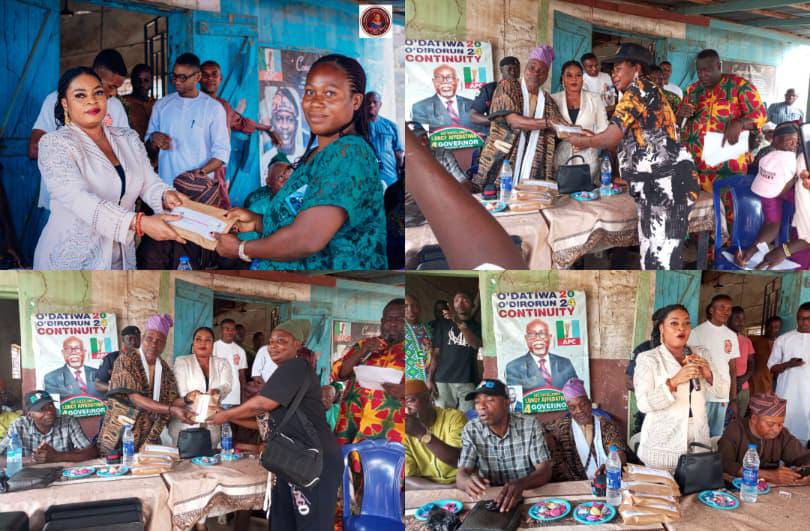
Earlier, in his welcome address, the State Chairman of ODSCIA, Alhaji Waheed Ademola Fadola, stated that the council distributed what it was able to generate within a year to the less privileged. He explained that beneficiaries were selected across the three senatorial districts — four from the Central Senatorial District and three each from the other two districts.
While urging participants to appreciate the gesture, Fadola charged beneficiaries to make judicious use of the items received.
He disclosed that over ₦2 million was raised in addition to the ₦500,000 donated by MUSWEN to implement the programme, and called for continued stakeholder support to ensure sustainability.
The empowerment programme featured the donation of over ₦250,000 in cash to Khadijat Blessing Abdula living with disability from Akoko North-East, , in addition to a grinding machine she also received.