
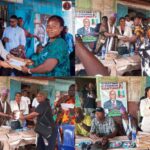



Stakeholders in the agricultural sector have called for action plans to address challenges facing Women Farmers, even as a Stakeholders’ Engagement on Land Access and Control has been organised by the Justice Development and Peace Centre (JDPC) in collaboration with ActionAid Nigeria, under the Strategic Partnership on Agroecology and Climate Justice (SPAC) project.
The engagement held on 29th January, 2026 in Akure, the Ondo state capital, brought together representatives of the Federal Ministry of Agriculture and Food Security, Ondo State Ministry of Agriculture, traditional institutions, civil society organisations, women farmer groups, and development partners to collectively seek solutions to land-related barriers undermining agricultural productivity.
The stakeholders specifically demanded that the Ondo State Government should urgently address the growing challenge of land access and control confronting smallholder farmers, particularly women and youths, as climate change continues to disrupt food production across the state.
Explaining the rationale behind the stakeholders’ engagement, JDPC Programme Officer, Olayemi Oluwatobi said over 24,000 women farmers had been trained by the organisation on agroecology.
Olayemi stated that research conducted by ActionAid and partners revealed land access as the biggest challenge facing trained agroecology beneficiaries.
“We have trained over 24,000 women farmers on agroecology. Without land, that training becomes meaningless,” Oluwatobi said.
The organisation’s Program officer pointed out that the goal was to secure commitments from government and traditional institutions to ensure sustainable access to land for cooperatives of trained farmers.
“This is not about one-off training. It is about sustainability, productivity and livelihood improvement,” JDPC officer noted.
He added that agroecology has already helped farmers reduce costs and improve household welfare.
“Many women now produce organic fertilisers themselves, save money on chemicals, and even contribute to paying their children’s school fees,” the organisation disclosed.
CLIMATE CHANGE WORSENING FARMERS’ STRUGGLES
Speaking at the event, Agbanimu Rufus, Coordinator of the Federal Ministry of Agriculture and Food Security, said the meeting was timely, noting that climate change has made traditional farming methods unreliable.
“Climate is already changing and it is ravaging agriculture. Rainfall no longer comes when it should. Crops like cocoa, cassava and yam no longer mature as expected. This is affecting both crops and livestock,” he said.
Agbanimu stressed that agroecology offers a sustainable response to climate uncertainty, adding that farmers must “innovate and migrate from archaic farming practices” to survive current realities.
“The climate our fathers farmed under is not the same climate we have today. If we don’t change our practices, we will regret it,” he warned.
He disclosed that the Federal Ministry plans to support farmers with training, inputs, implements and modern techniques, while also working with states to strengthen land access mechanisms.
WOMEN FARMERS DECRY LACK OF LAND
The SWOFON (Small Scale Women Farmers Organisation of Nigeria) leader, Mrs Bukola Oyediji lamented that despite extensive training in agroecological practices, many women farmers are unable to farm due to lack of land.
“ActionAid has trained many of us in agroecology. We know what to do, but we don’t have land. In some communities, there is simply no land allocated to women,” she said.
She appealed to both federal and state governments to deliberately allocate land to women farmers, stressing their central role in food production.
“Without production, there is no processing or marketing. Women are ready to work, but we need land,” she added.
LAND OWNERSHIP IS SENSITIVE, State Government charged
Responding, Agbanimu cautioned that land remains a sensitive issue, emphasizing that “there is no empty land anywhere.”
“Land cannot be manufactured. Every land belongs to someone or a community. That is why farmers must work closely with the State Ministry of Agriculture and community leaders to avoid conflict,” he said.
STATE GOVERNMENT EXPLAINS LAND ACCESS INITIATIVE
Also speaking, the Permanent Secretary, Ondo State Ministry of Agriculture, Mrs Foluke Daramola revealed that the state is implementing a land access initiative known as “FRELIA”, a partnership involving the state government, federal government and the World Bank.
“Through FRELIA, we have already secured about 26,000 hectares of land across the state for agricultural investment,” she said.
She explained that the programme ensures land is accessed through community engagement to prevent disputes.
“We carry the youth, women, traditional rulers and landowners along. The state government stands as surety to guarantee peaceful access to land,” she added.
The Permanent Secretary reaffirmed the state’s commitment to supporting women and youth farmers.
“Secure and equitable access to land is key to unlocking productivity. Ondo State remains committed to empowering women and young farmers and promoting agroecological practices,” she said.
CALL FOR COLLECTIVE ACTION
Participants agreed that addressing land access challenges requires collaboration among government, traditional institutions, civil society and communities.
The meeting ended with a call for policy reforms, increased community engagement and deliberate land allocation for women and youth farmers to boost food security and climate resilience in Ondo State.


